Your eight-week-old pup spots a squirrel across the street, and suddenly the leash goes taut, the barking starts, and you're practically water-skiing down the sidewalk. Sound familiar? Puppy leash reactivity is one of the most common concerns new owners bring to trainers — and the good news is that catching it early makes an enormous difference. The tricky part is knowing whether your puppy is just being a puppy or whether those big, noisy reactions are the first signs of a pattern worth addressing now.
Key Takeaways
- Most puppies under 12 weeks show excitement and overstimulation on leash — not true reactivity.
- True leash reactivity involves a consistent pattern of lunging, barking, or freezing triggered by specific stimuli.
- The socialization window (3–16 weeks) is your most powerful tool — use it wisely.
- Age-appropriate training can begin as early as 8 weeks, but methods must match the puppy's developmental stage.
- Early, humane intervention dramatically reduces the chance of reactivity becoming a lifelong habit.
What Leash Reactivity Actually Means
The term "leash reactive" gets thrown around a lot, but it has a specific meaning. A leash-reactive dog displays exaggerated, repetitive responses — lunging, barking, spinning, or freezing — when it encounters a particular trigger while on leash. Common triggers include other dogs, strangers, cyclists, skateboards, and fast-moving vehicles.
The leash itself is part of the equation. When a dog is tethered and cannot approach or flee freely, it experiences what trainers call barrier frustration. That frustration gets expressed through the behaviors we see — and the more often a puppy rehearses those behaviors, the stronger the neural pathway becomes.
It's worth noting that reactivity is not the same as aggression, though the two can overlap. Many reactive puppies are actually over-excited rather than fearful or hostile. Understanding the emotional root of the behavior is essential for choosing the right training approach — which is why rushing to "fix" the behavior before you've identified the cause can backfire.
What Leash Reactivity Actually Means
🐾 Fun Fact:
Leash reactivity is more common in certain breeds wired for high arousal or strong prey drive — think Border Collies, German Shepherds, and Labrador Retrievers — but any puppy can develop it if early experiences are inconsistent or overwhelming.
Normal Puppy Excitement vs. Early Reactivity: How to Tell the Difference
This distinction matters enormously, because the strategies for handling normal over-excitement look different from those for addressing early reactivity. Here's a practical framework:
Signs That It's Probably Normal Excitement
- Your puppy pulls toward the trigger with a loose, wiggly body and a high, wagging tail.
- The reaction calms quickly once the trigger passes or your puppy gets closer.
- Your puppy can be redirected with a treat or a cheerful cue most of the time.
- The behavior happens with everything — dogs, people, leaves blowing in the wind — rather than specific consistent triggers.
Signs That It May Be Early Reactivity
- The body goes stiff before the lunge — ears forward, tail high and rigid, or tucked low.
- Barking is loud, repetitive, and difficult to interrupt even with high-value treats.
- The reaction escalates rather than settles as the trigger approaches.
- Your puppy consistently reacts to the same category of trigger (e.g., always other dogs, always men in hats).
- Recovery time after the trigger passes is long — your puppy stays in an aroused state for minutes.
If you're seeing the second list more than the first, it's time to be proactive. These are also some of the same common puppy behavior problems that escalate when owners unintentionally reinforce them — so acting early matters.
🧠 Think About:
Ask yourself: does my puppy's body look loose and happy, or stiff and intense? Body language is the single most reliable indicator of whether a reaction is rooted in excitement or stress — and it shapes every training decision you'll make.
Understanding the Socialization Window (and Why It's So Important)
Behavioral science consistently identifies the period between 3 and 16 weeks of age as the primary socialization window. During this time, a puppy's brain is primed to form associations with the world — associations that become the emotional baseline for how the dog responds to novelty throughout its life.
What this means practically: a puppy that has calm, positive exposures to other dogs, strangers, traffic, and assorted environments during this window is far less likely to develop leash reactivity than one whose world stays small and unstimulating. The American Kennel Club emphasizes that socialization quality matters as much as quantity — one frightening experience can create a lasting negative association, while dozens of calm, well-managed ones build resilience.
The mistake many owners make is either overdoing it (flooding a timid puppy with too many stimuli at once) or underdoing it (waiting until vaccinations are complete before venturing outside, by which point the best of the socialization window has passed). A middle path — carefully managed, positive exposure — is the goal.
Once the socialization window narrows after 16 weeks, new experiences become more likely to trigger caution rather than curiosity. That doesn't mean training later is impossible — it just takes more repetition and patience.
An Age-Appropriate Training Plan: 8 Weeks to 6 Months
Here's the honest truth: there is no single start age for leash reactivity training, because puppies develop at different rates and triggers vary. But the following phase-based framework gives you a reliable roadmap.
Phase 1: 8–12 Weeks — Foundation and Exposure
At this stage, formal leash training isn't really the priority — association-building is. Focus on:
- Introducing the harness and leash indoors with lots of praise and tiny treats.
- Short outdoor excursions (5–10 minutes) in low-stimulus environments — a quiet street, a calm yard.
- Letting your puppy observe other dogs and people from a comfortable distance without forcing interaction.
- Marking calm behavior with a verbal marker ("yes!") and a treat whenever a potential trigger appears.
Phase 2: 12–16 Weeks — Introducing Focus Work
Now you can start teaching your puppy to check in with you voluntarily. Eye contact on leash is the cornerstone skill here:
- Reward every spontaneous glance your puppy offers you outdoors.
- Practice "watch me" in progressively more distracting environments.
- Begin learning about loose-leash walking fundamentals so your puppy associates a slack leash with good things.
- If a trigger appears, increase distance before your puppy reaches threshold — the point at which it can no longer think clearly.
Phase 3: 4–6 Months — Systematic Desensitization
By now your puppy has some impulse control and leash manners. This is when you can begin structured desensitization and counter-conditioning:
- Desensitization: exposing the puppy to the trigger at a distance where no reaction occurs, then gradually decreasing that distance over many sessions.
- Counter-conditioning: pairing the trigger's appearance with something the puppy loves (a high-value treat, a game) so the emotional response begins to shift from arousal or fear to anticipation of good things.
- Keep sessions short (5–10 minutes) and always end before your puppy goes over threshold.
- Progress is not linear — expect good days and setbacks, and track patterns rather than individual sessions.
💡 Tip:
Always work "below threshold" — the distance at which your puppy notices the trigger but stays calm enough to take treats and respond to cues. If your puppy is barking or lunging, you've gone too close too fast. Increase the distance and start again.
Common Mistakes That Make Puppy Leash Reactivity Worse
Good intentions can sometimes fuel the very behavior we're trying to reduce. Here are the most common pitfalls — and what to do instead:
- Tightening the leash as the trigger approaches. A tight leash signals danger to your puppy and raises arousal. Practice keeping a loose J-curve in the leash even when you're nervous.
- Saying "it's okay" in a soothing voice repeatedly. This can actually reinforce the emotional state rather than calm it. Instead, act matter-of-fact — cheerful but neutral.
- Letting your puppy "meet" the trigger to calm down. For a truly reactive puppy, this often results in a chaotic, over-stimulating greeting that rehearses bad habits. Controlled distance is almost always better than uncontrolled proximity.
- Skipping management while training. Training takes time. In the meantime, actively manage your environment: cross the street early, walk at quieter times of day, use a front-clip harness for better steering. Management prevents rehearsal, and preventing rehearsal prevents the behavior from getting stronger.
- Using punishment or leash corrections. Aversive techniques applied during a moment of fear or frustration can create a direct association between the trigger and pain or fear — the opposite of what you need. Stick with positive reinforcement.
For a broader look at how everyday habits can inadvertently shape problem behavior, the everyday dog care guide that helps prevent problems before they start is a practical read alongside this training plan.
📌 Example:
Say you're on a walk and a jogger approaches. Instead of bracing and shortening the leash, turn and walk the other way cheerfully, calling your puppy's name. The moment your puppy follows you and looks at you, mark and treat. You've just rewarded disengagement from the trigger — exactly the skill you need.
How Can PawChamp Help?
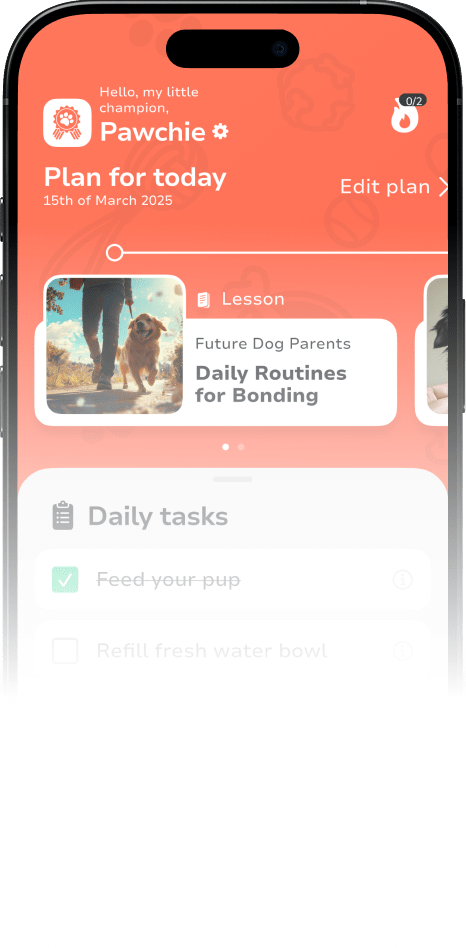
PawChamp is designed to make personalized, expert-backed training accessible from the moment you bring your puppy home — especially for nuanced challenges like leash reactivity.
- Personalized training plans: Answer a short quiz about your puppy's age, breed, and specific triggers, and PawChamp builds a step-by-step reactivity training plan matched to your puppy's current developmental stage.
- Expert-verified lessons: Every lesson in the app is reviewed for accuracy and humane methodology, so you're never guessing whether the technique you're using is appropriate for a young puppy.
- In-app expert chat: Got a specific question — like whether your puppy's reaction to cyclists is fear-based or excitement-based? Connect directly with a Dog Training Expert or a Dog Health and Care Expert inside the app for personalized guidance.
Whether you're at the earliest socialization phase or already seeing consistent reactivity patterns, PawChamp meets you where your puppy is — and maps out exactly where to go next.
Bottom Line
Puppy leash reactivity exists on a spectrum — most young puppies show excitement and overstimulation that resolves with consistent training, but some show early signs of true reactivity that benefit from structured intervention starting as early as 8 weeks. The socialization window between 3 and 16 weeks is your greatest asset, and using it with calm, positive exposures can prevent a lifetime of leash struggles. Catching the pattern early, working below threshold, and staying consistent with positive reinforcement gives your puppy the best possible chance of becoming a calm, confident walker.